Prototype
Proc
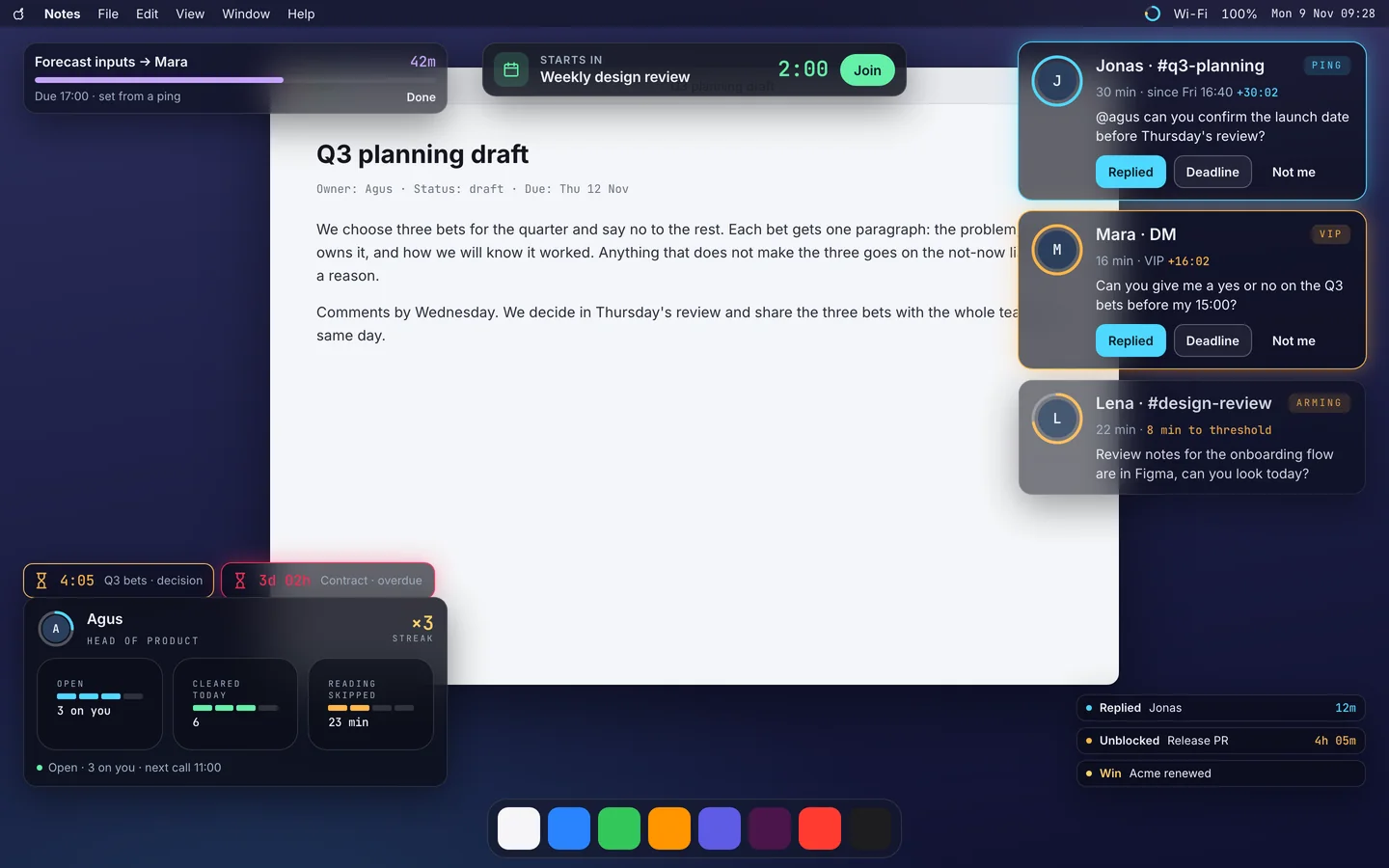
Shows what needs you, when it needs you, and stays out of the way otherwise.
I build the first version of a tool on a real problem myself. Then the team takes it over and extends it. That is how a product organisation becomes AI-native: by example first, then by everyone.
At work
Form live in the app · triage not running
A feedback form members reach in the app, with an LLM triage and clustering step designed behind it.
LLM pipelineembeddings
Every entry graded before it counts
Grouped by meaning, not keyword
Bubble size shows relative cluster size. Sample themes.

At work
Used mainly by product
Planning tool that keeps strategy and delivery in one view, with partner-facing items flagged explicitly rather than guessed.
Next.jsPostgresClaude Code
Now
SAMPLE-101
Sample initiative — onboarding rebuild
Activation
SAMPLE-104
Sample initiative — billing clarity
Retention
Next
SAMPLE-112
Sample initiative — discovery surface
Engagement
SAMPLE-118
Sample initiative — referral loop
Acquisition
Later
SAMPLE-130
Sample initiative — partner tooling
Supply

On my own timeIn use
German-learning PWA in daily use: Leitner spaced repetition, speech practice, offline-first.
Next.jsTypeScriptAnthropic APIClaude Code
Leitner boxes
Choose a card
die Verantwortung
Answer
responsibility
Correct → moves to Box 3 (weekly)
der Anspruch
Answer
claim, standard
Correct → moves to Box 2 (every 3 days)
nachhaltig
Answer
sustainable
Correct → moves to Box 5 (monthly)
die Entscheidung
Answer
decision
Correct → moves to Box 4 (fortnightly)

I specified a way for people outside the data team to ask our numbers questions in plain language, and wrote the acceptance tests. When we graded it on real questions, most answers were right; the misses came from definitions we hadn’t written down. I signed it off anyway, expecting use to close the gaps. Instead, people read its answers as fact. We paused it. Definitions before tools.
Things I'm building on my own time. Not in daily use yet, and labelled for what they are.
Prototype
Shows what needs you, when it needs you, and stays out of the way otherwise.
Tools are the easy part. These are the rules I learned by getting them wrong.
I asked a coding agent to fix a feedback digest that looked broken. The rebuild report showed it had worked all along, and the rebuild had quietly switched it from daily to weekly and dropped anomaly detection. I kept the original, and cadence became a product decision instead of a side effect.
A model that answers questions about the numbers is only as right as the definitions under it, and people read its answers as fact. Write the definitions down before anyone gets access.
An AI digest that turns three complaints into "users are frustrated" sends a team to build the wrong thing. Mine reported counts, never adjectives. Anything under five items is marked directional, quotes are verbatim, and anything it can't classify goes to a person.
An end-of-day brief cost hours of compute on the most expensive model for a summary nobody needed at 17:30. I deleted it, kept the morning one, moved it to a cheaper model and capped it at one call per source. Scheduled agents fail on cost before they fail on quality. And a model that's validated isn't the same as one that's switched on: I paused one because the data underneath it was being replaced.
In a side project that decides which messages need my attention, the model runs alongside simple rules first. Users' real actions are the ground truth, and the model only takes over once it beats the rules on the same events. If it errors, the rules take over. It never silently hides anything.
I've evaluated open-weight models for cost and data residency and haven't run one in production, and I'll say so. What I do know deeply is subscription and marketplace economics, and that's what decides whether a tool measures the right thing. "Feature-level MRR" doesn't exist in a subscription business, however confidently a model computes it.
This site's build fails if a claim I've retired, an internal number or a client name reaches the page. AI writing drifts toward the plausible, so I don't rely on catching it by eye.
Most companies now have dozens of people asking AI the same questions, each starting from scratch: what does this metric mean, who owns this, why did we decide that. I'm exploring what a shared "second brain" for a company would look like. It would be a small, curated layer that tells any AI assistant what's true about the business today, what was decided and why, and which sources to trust over others, with live tools fetching the details on demand. The interesting problems aren't technical. They're keeping it current without anyone writing a wiki, separating a brainstorm from a decision, and deciding what never goes in. Early thinking, nothing built yet.